

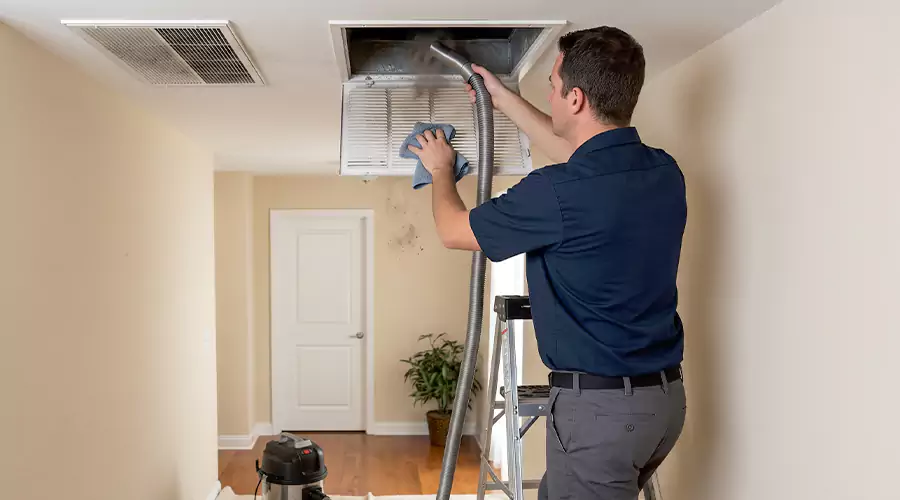
NADCA-certified air duct cleaning refers to HVAC cleaning performed by professionals with credentials from the National Air Duct Cleaners Association (NADCA), or by companies that meet its membership requirements and follow its cleaning standards. NADCA certifies individual specialists through its Air Systems Cleaning Specialist (ASCS) program, while member companies must employ qualified personnel and meet specific professional requirements.
Air duct cleaning involves removing accumulated dust, debris, and other contaminants from heating and cooling systems. The work may include supply ducts, return ducts, plenums, registers, and other HVAC components. Because many parts of these systems are concealed, homeowners often rely on professional qualifications when selecting a cleaning company.
NADCA provides industry standards, training, and certification programs intended to improve HVAC inspection, cleaning, and restoration practices. Understanding these credentials can help homeowners distinguish documented qualifications from unsupported advertising claims.
What Does NADCA Stand For?
NADCA stands for the National Air Duct Cleaners Association. It is an international trade association representing professionals and companies involved in HVAC inspection, cleaning, and restoration. The range of work its members perform covers air duct cleaning services across residential and commercial systems.
The organization develops industry standards and provides educational resources and certification programs. Its ACR Standard addresses procedures for assessing, cleaning, and restoring HVAC systems.
NADCA membership is not a government license. Instead, it indicates that a company has met the association's membership requirements and agreed to follow its professional standards.
What Is ASCS Certification?
The Air Systems Cleaning Specialist (ASCS) certification is NADCA's professional credential for individuals working in HVAC system cleaning. It recognizes knowledge of duct cleaning methods, HVAC hygiene, applicable standards, and safety practices.
Candidates must pass an examination to obtain the credential. Certified individuals must also meet renewal and continuing education requirements to maintain their status.
NADCA certifies individuals, not entire companies, through the ASCS examination. A business advertising itself as NADCA-certified should therefore be able to explain whether it means that it is a NADCA member or that its employees hold ASCS credentials.
What Are the Requirements for NADCA Membership?
NADCA requires regular member companies to meet specific professional conditions. These requirements help establish a baseline for companies representing themselves as NADCA members.
| Requirement | What It Means |
|---|---|
| ASCS-certified employee | The company must have at least one qualified specialist on staff |
| Liability insurance | The company must maintain appropriate insurance coverage |
| NADCA ACR Standard | The company agrees to follow the association's cleaning standards |
| Code of Ethics | The company agrees to follow professional conduct requirements |
| Continuing education | Certified specialists must maintain their credentials |
| Membership verification | Current membership can be checked through NADCA |
Membership requirements do not mean that every employee automatically holds ASCS certification. Homeowners should ask who will supervise the cleaning and what training the assigned technicians have received.
How Does NADCA-Certified Air Duct Cleaning Work?
Professional cleaning typically begins with an inspection of the HVAC system. The contractor identifies the duct materials, contamination, access points, and components included in the service.
NADCA's ACR Standard emphasizes source-removal cleaning. Technicians use suitable agitation equipment to loosen deposits while negative-pressure vacuum equipment collects the material.
- Step 1. Inspect the HVAC System: The technician examines accessible supply and return passages and relevant HVAC components. This assessment helps establish whether cleaning is necessary and which methods are appropriate.
- Step 2. Prepare and Protect the Work Area: Technicians protect nearby furnishings and prepare their collection equipment. Suitable containment procedures help prevent loosened dust from spreading into occupied rooms.
- Step 3. Establish Negative Pressure: Specialized vacuum equipment creates negative pressure within the section being cleaned. This supports the collection of loosened dust and debris during the cleaning process.
- Step 4. Remove Accumulated Material: Technicians use appropriate brushes, air-powered tools, or other agitation devices to dislodge deposits. The tools should be compatible with rigid metal, flexible ductwork, or insulated duct surfaces.
- Step 5. Clean Included HVAC Components: Depending on the agreed scope, cleaning may extend to plenums, registers, blower components, and other relevant equipment. Specialized components must be serviced using suitable procedures.
- Step 6. Complete Final Verification: The contractor checks the cleaned areas, restores access panels, and confirms that the system is properly reassembled. Homeowners can request photographs or a visual inspection of representative duct surfaces.
What Are the Benefits of Choosing a NADCA Member?
Choosing a verified NADCA member provides a way to check whether a company has satisfied recognized industry membership requirements. It also offers a reference standard for discussing how the cleaning should be performed.
An ASCS-qualified specialist can help identify appropriate methods for different duct materials. This matters because aggressive cleaning may damage flexible liners or fiberglass duct board.
Membership does not guarantee that every cleaning will produce a particular health or energy-saving result. The actual work quality, system condition, and technician experience remain important.
Is NADCA-Certified Cleaning Better Than Regular Duct Cleaning?
The main distinction is the presence of verifiable professional credentials and a commitment to recognized cleaning standards. Some nonmember contractors may also perform appropriate cleaning, but homeowners must evaluate their procedures independently.
A NADCA member should be able to describe how it applies the ACR Standard. Ask about vacuum collection, mechanical agitation, system inspection, and the components included.
The contractor should also explain when cleaning is unnecessary. The Environmental Protection Agency (EPA) does not recommend routine residential duct cleaning without a specific reason.
Does NADCA-Certified Cleaning Improve Indoor Air Quality?
Removing substantial contamination can be appropriate when ducts contain excessive debris or other documented problems. However, the EPA states that routine residential duct cleaning has not been shown to consistently prevent health problems or improve indoor airborne dust levels.
NADCA certification indicates professional knowledge rather than a guarantee of medical benefits. Cleaning cannot correct every source of indoor pollution, including moisture problems, outdoor particles, and household activities.
Claims promising complete allergen elimination or guaranteed energy savings should be treated cautiously.
How Much Does NADCA-Certified Air Duct Cleaning Cost?
Professional air duct cleaning prices depend on the property's size, number of HVAC systems, accessibility, and cleaning scope. Published U.S. estimates commonly place residential cleaning in the several-hundred-dollar range, while large or complicated systems may cost more.
NADCA does not establish one mandatory residential cleaning price. Membership alone does not determine what a contractor charges.
Request an itemized estimate identifying supply and return duct cleaning, included HVAC components, equipment setup, and final inspection. Compare the actual work rather than assuming the highest or lowest quote represents the best service.
How Can You Verify NADCA Certification?
Visit the official NADCA website and use its Find a Professional directory. Search for the company and confirm its current membership status.
Ask the contractor to identify its ASCS-certified specialist and clarify that person's role in supervising the project. NADCA also provides membership certificates showing company information and expiration dates.
Be cautious of businesses displaying a NADCA logo without verifiable membership. The organization has warned that some businesses falsely claim affiliation.
Conclusion
NADCA-certified air duct cleaning is associated with trained HVAC cleaning specialists and companies following recognized industry standards. ASCS certification applies to individuals, while NADCA membership applies to businesses meeting the association's requirements. Homeowners should verify credentials, review the cleaning scope, and understand how the contractor will remove and collect debris. Certification is a useful qualification, but it does not guarantee health improvements or eliminate the need to assess the actual work.